
Different Types of Japanese Tattoo Design
People come into Red Point Tattoo with a camera roll of Japanese images: a hannya mask, a koi, a wave, a tiger. Any one of those can make a good tattoo. The difficulty is putting all of them on the same arm when they do not belong in the same picture. In the prints this work comes from, the flower, the animal and the background are chosen together. Spring looks like spring. A river creature gets water. A pair of gods is drawn as a pair. If you are planning a Japanese design, start with that.
You may have previously seen our posts about traditional Japanese designs or Japanese art and folklore. Here we'll look at variety of different Japanese designs available.
Choose a season or a story, then add the things that fit it. The studio is in North London. If you work in central London, you can come up on a lunch break. Walk-ins are welcome when you want to talk a design through, or get something small if an artist is free and the drawing is straightforward. A sleeve or a back piece needs an appointment, so there is time to draw it before anyone starts tattooing.
Seasons
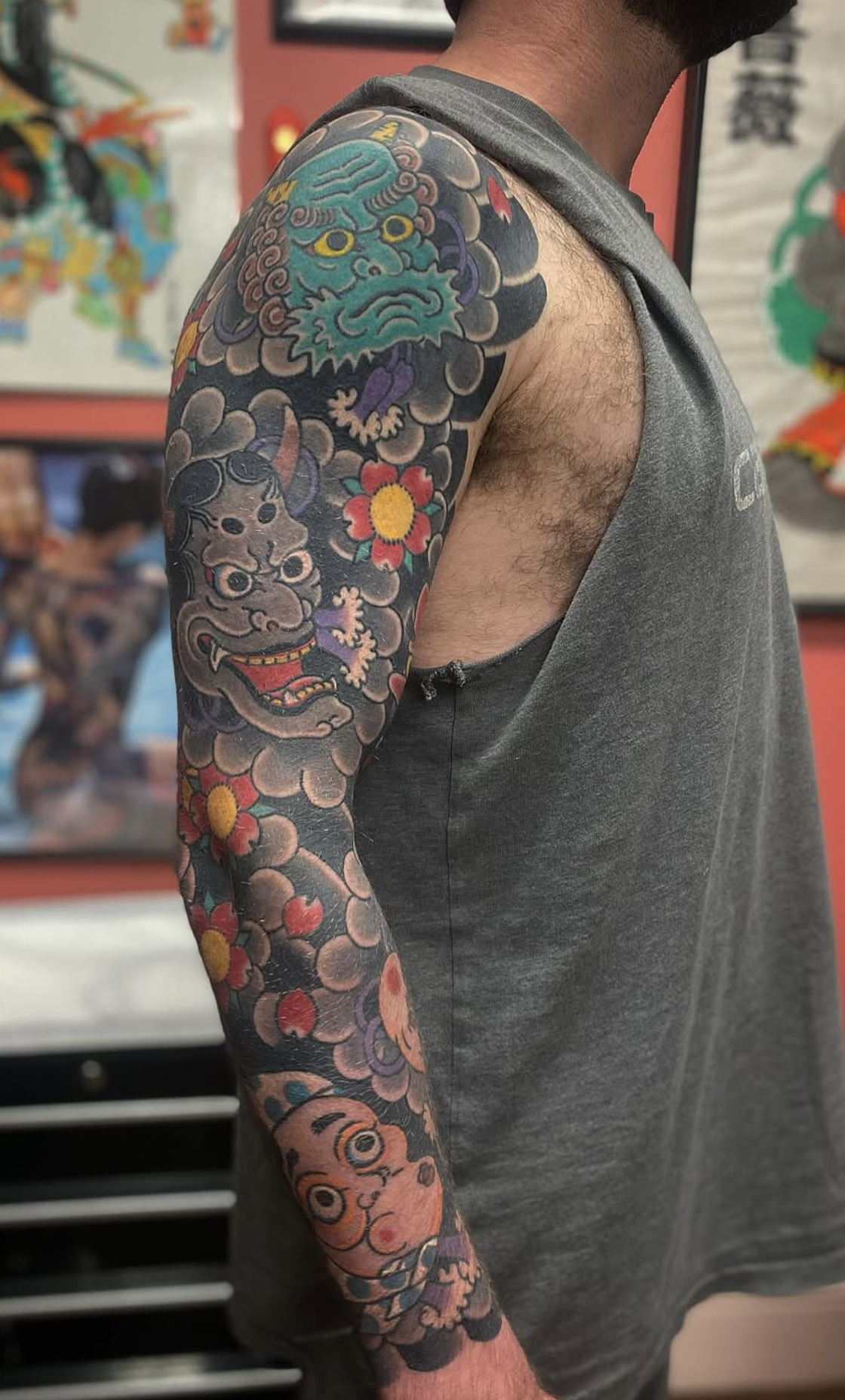
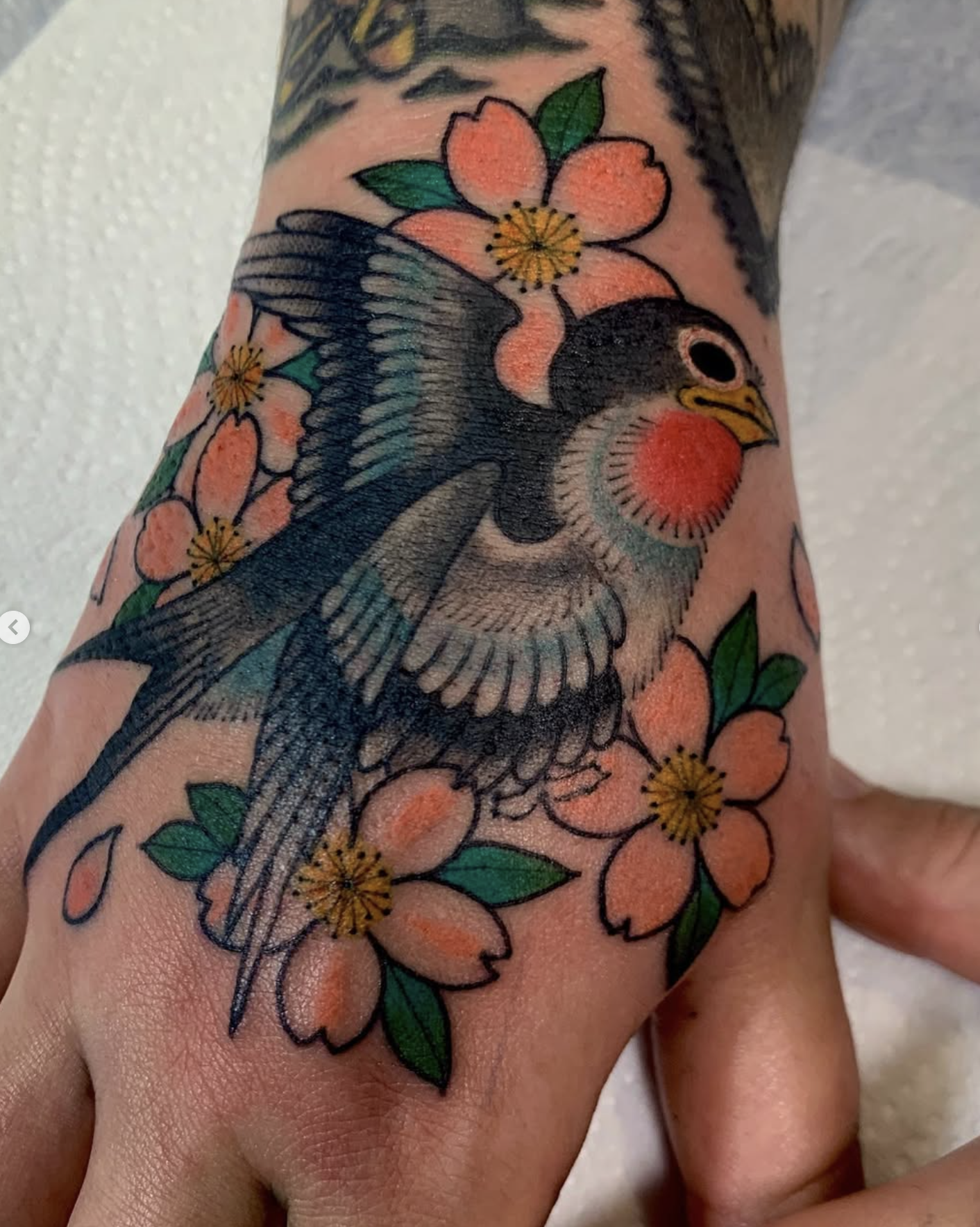
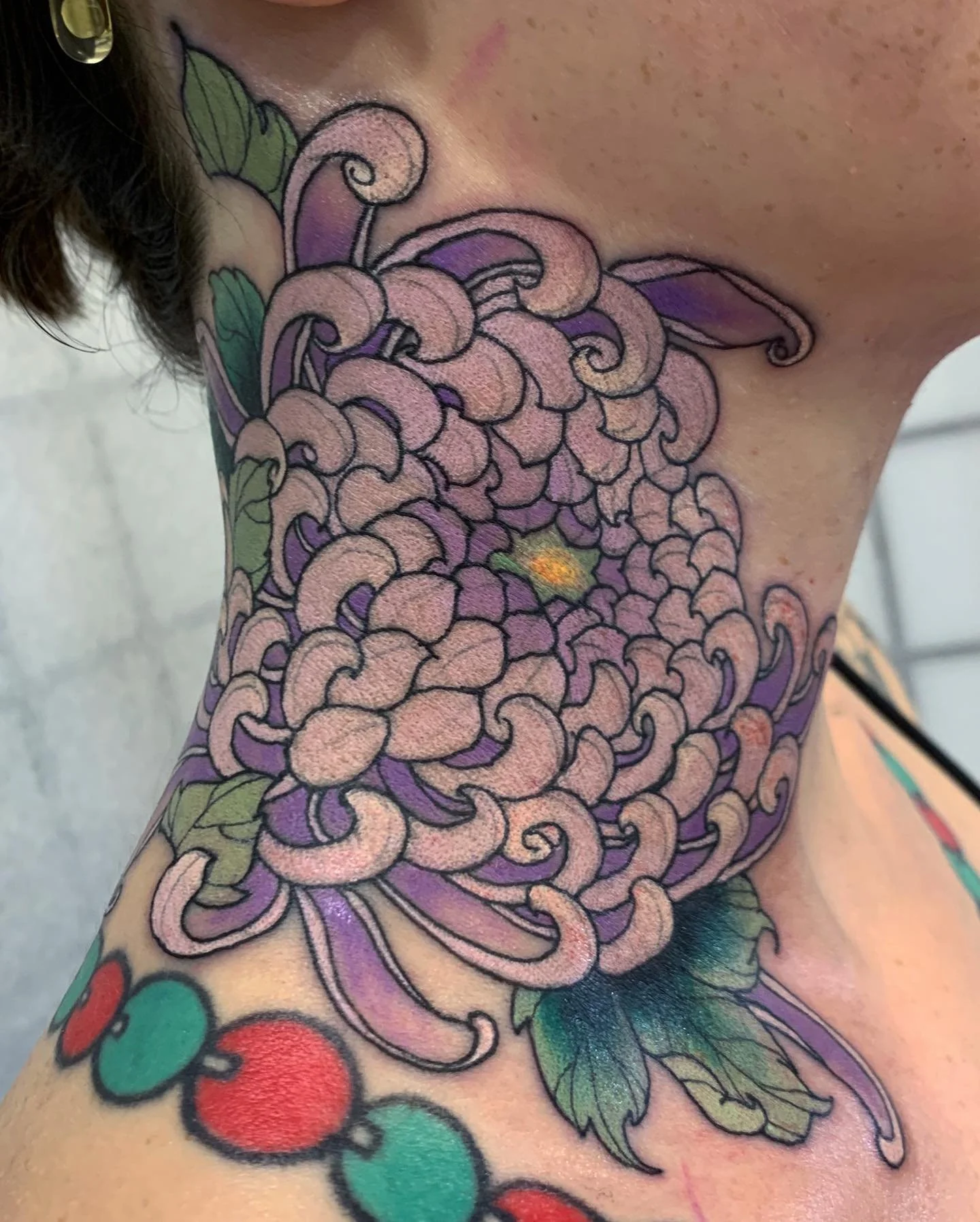
Traditional Japanese pictures usually stick to one time of year. Cherry blossom is the spring flower. Prints often show the petals falling, because the blossom does not last. Summer designs use peonies, koi and water. Peonies are commonly paired with a lion-dog or a snake. Autumn uses maple leaves and chrysanthemums. Winter uses pine, plum blossom and cranes. For a tattoo, one flower and one animal from the same season is usually enough, with some background around them. Wind, cloud, waves or leaves stop the main image looking stuck on. If a sleeve starts with cherry blossom and you add peonies later, you have mixed spring and summer, and it stops reading as one design. Tell us the season when you come in. If you only know it as "the cherry blossom one" or "the one with maple leaves", that is enough to start from. If you are not sure what usually goes with the thing you want, bring that reference and we will suggest the common pairings.
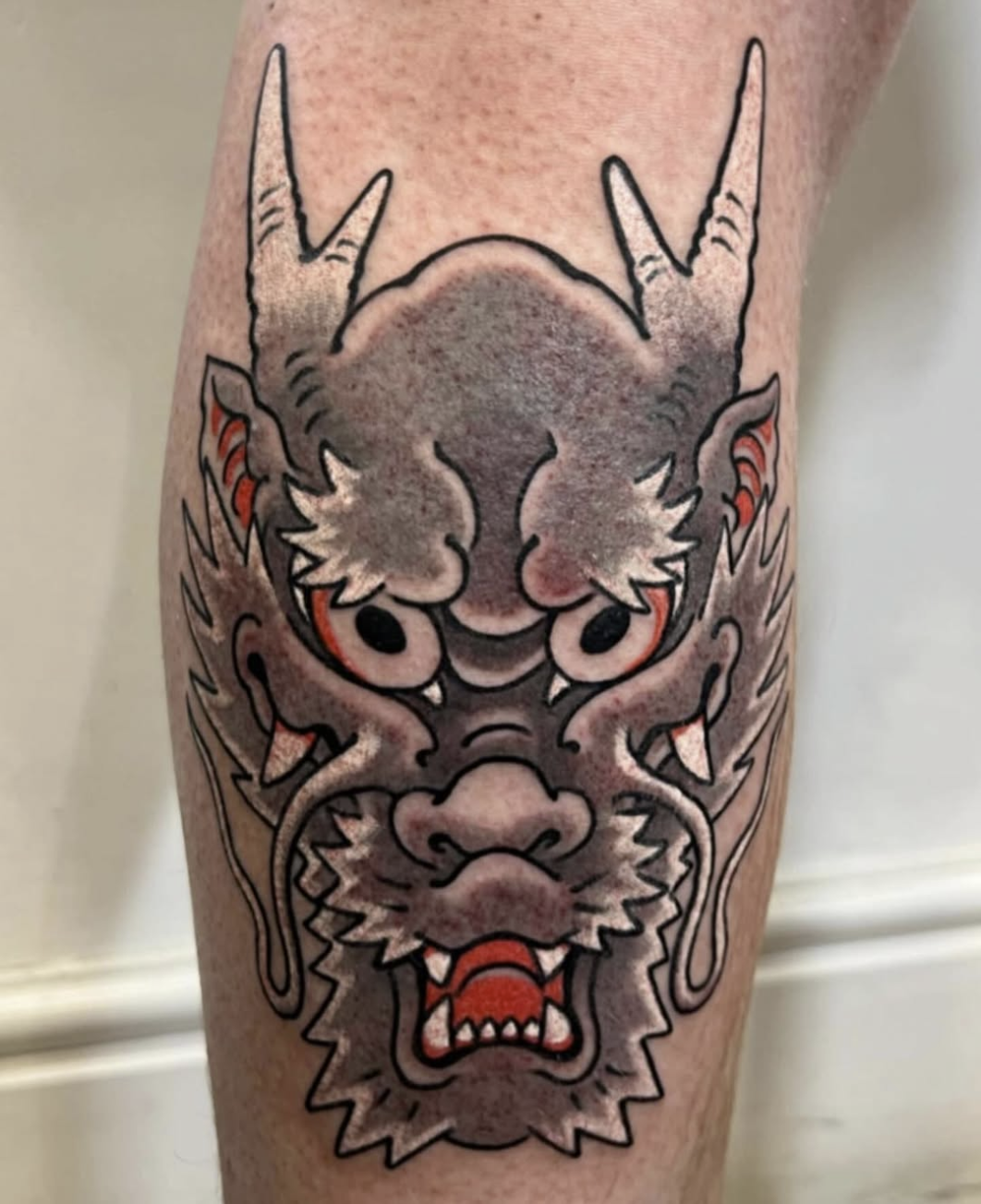
Some animals come with a story, and the story decides what else should be in the tattoo. Japanese tattooing took on a Chinese legend about a koi that swims up a waterfall, the Dragon Gate, and turns into a dragon. If you want the climb, include the waterfall. If you want the transformation, include the dragon. Japanese dragons are water creatures, usually drawn with rain clouds and a pearl. Tigers are all over Japanese prints, even though Japan had no wild tigers. Painters borrowed them from Chinese art, often next to bamboo. If you want a tiger, bamboo is the usual background.
Woodblock prints
The heavy black outlines and flat colour in Japanese tattoos come from ukiyo-e woodblock prints. Those prints showed actors, warriors, courtesans, landscapes and ghosts, and they were made to be understood at a glance. A tattoo has to work that way too, from across a room. Hokusai and Kuniyoshi are the names we hear most often at Red Point Tattoo. Hokusai's Great Wave is one print from Thirty-six Views of Mount Fuji, made around 1831. When someone asks for a Japanese wave, this is almost always the picture they mean. We can use that curl on a shoulder or a forearm. Copying the entire print, line for line, onto a bicep rarely works. An arm is not a flat sheet of paper.
Kuniyoshi's pictures of the 108 Suikoden heroes, published in the late 1820s, are a large part of why Japanese tattoos look like this. The heroes come from a Chinese novel, and he drew many of them covered in tattoos: dragons, flowers, figures across the chest and arms. Those prints helped make big pictorial tattoos fashionable in Japan. You might want a Japanese sleeve without knowing any of that, and still be picturing this kind of image. If you have a particular hero in mind, bring a photo of the print or the name. A large piece based on these needs a drawing before the tattoo day. You can walk in with the reference and book that drawing.
Ghosts and actor prints
Yoshitoshi's ghost prints, from the late nineteenth century, are a useful reference if you want something stranger than a wave or a warrior. The figures have a clear outline, which is what you need when the image is going on skin. Actor prints are worth looking at for the same reason. A specific role, with the right clothes and a definite expression, makes a better tattoo than a generic samurai from a Google search. Pictures of courtesans work the same way. Choose one print, with a season and a pattern in the cloth, rather than asking for a Japanese woman with a fan and hoping for the best.
The British Museum holds a large collection of these prints. If you are in central London, you can see them on a lunch break before you come up to the studio. Look at how the empty parts of the page are filled with spray, cloud and leaves. On a body, the awkward areas are the knee, the edge of the armpit, and the skin above the hip. A design that only works in the middle of a thigh will look unfinished once it has to go round those spots.
Folklore
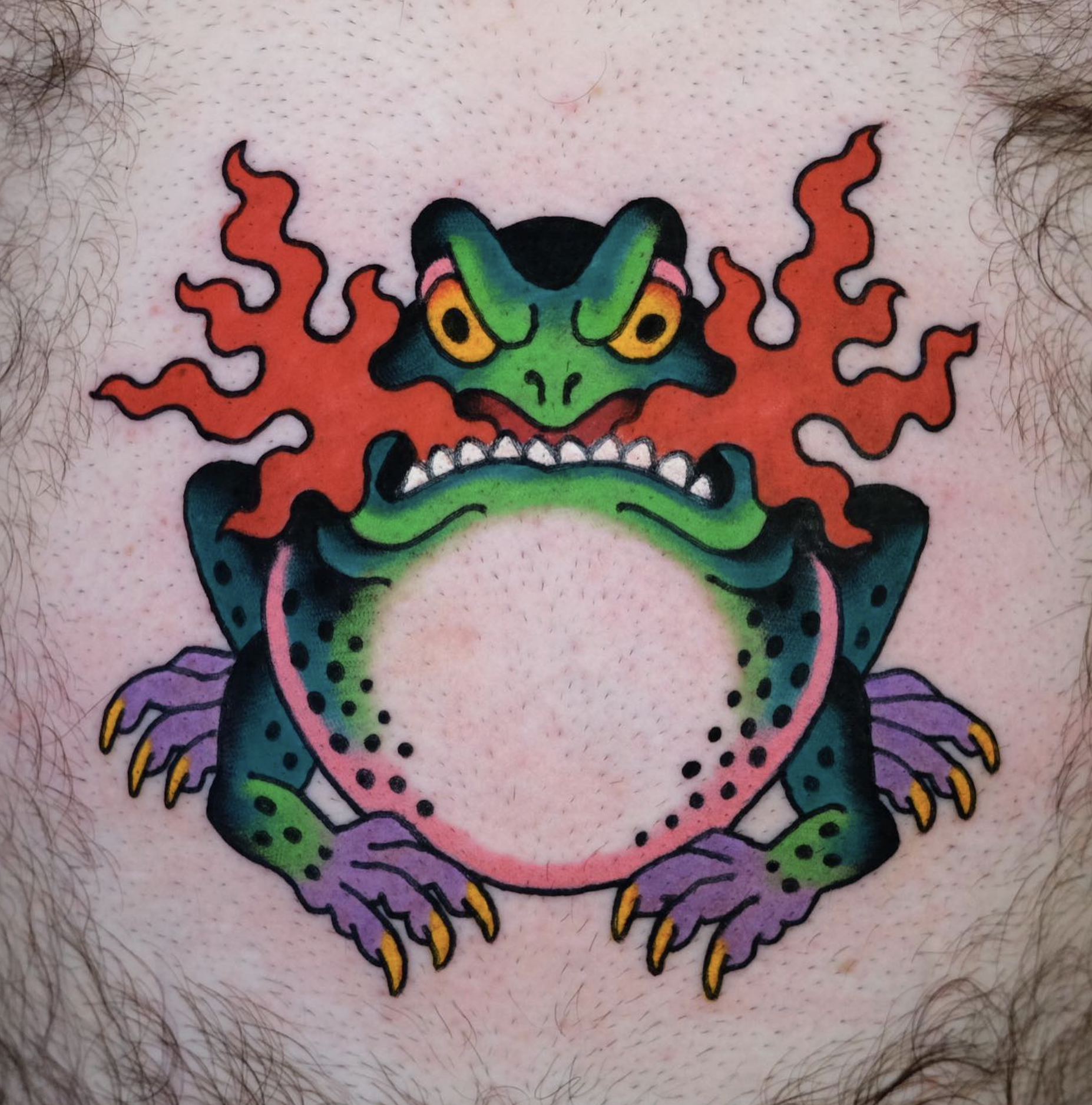
Each of the usual creatures belongs somewhere. A kitsune is a fox spirit. Foxes are the messengers of Inari, a Shinto kami associated with rice and prosperity. In other stories they trick people, sometimes while disguised as a human. More tails mean an older, more powerful fox, up to nine. If you want one, decide whether it is a shrine fox or a trickster. The background follows from that. A tengu lives in the mountains. The long-nosed tengu is linked with pride and with swordsmanship. There is also a crow-like tengu. Both are drawn with pine and rock. A kappa is a creature that lives in rivers. It has a dish of water on its head, and in the stories it loses its strength if it bows and spills the water. People offered them cucumbers. A kappa can work well at a smaller size, if you want something unpleasant that is also slightly absurd. An oni is a demon, drawn with horns and often an iron club. Say if you want it threatening or protective. The face is not the same.
These can share a tattoo, as long as they share a setting. A kappa needs a river. A tengu needs a mountain. A kitsune needs something that reads as a shrine. Four of them in a row, with nothing between them, looks like a sheet of flash. Bring the list in and we can cut it down before drawing the whole thing.
Masks and figures that are usually paired
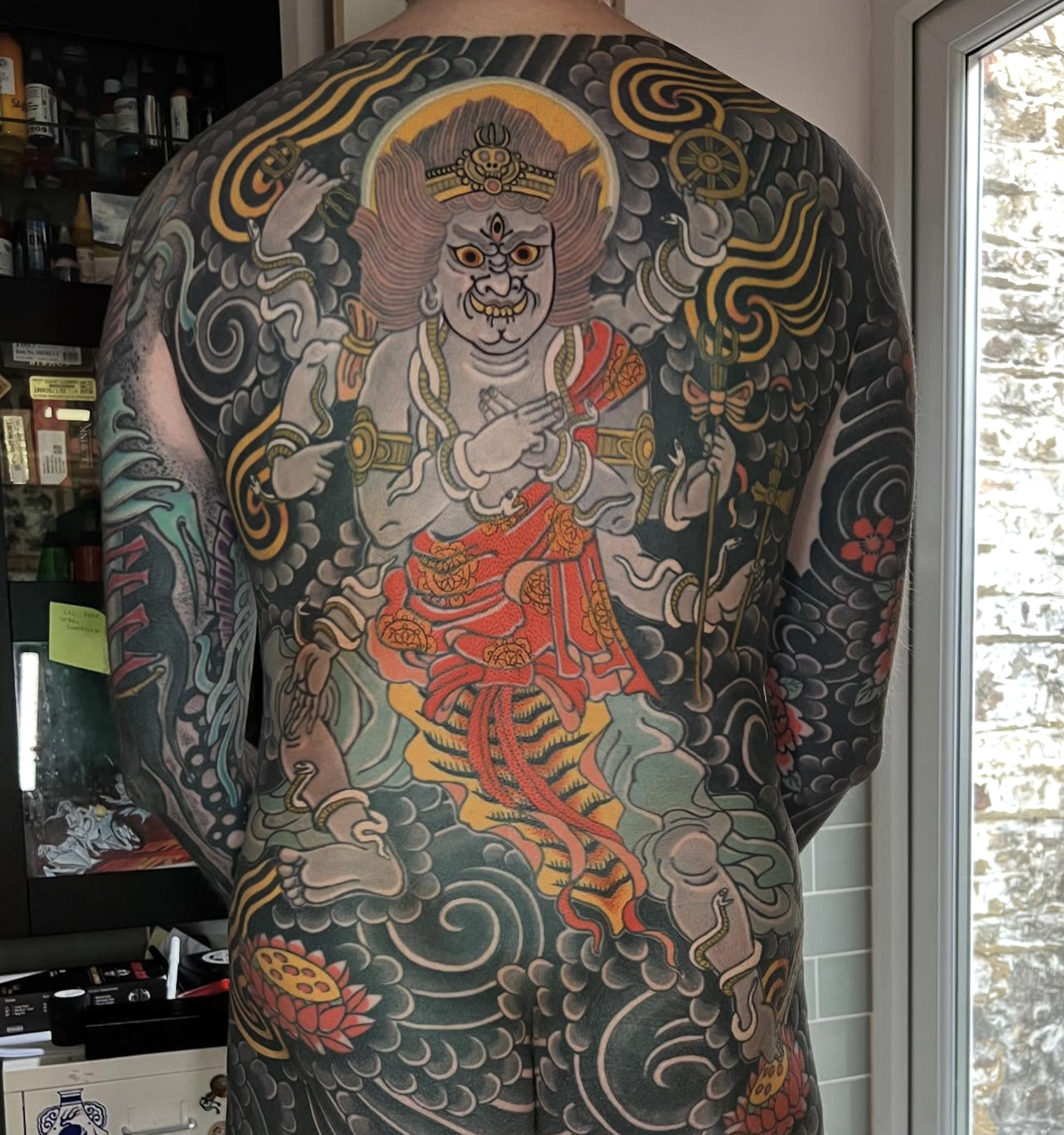
A hannya is a mask from Noh theatre. It is a woman whose jealousy has turned her face demonic, and the better masks still look grief-stricken as well as angry. Tell us which of those you want to see. Hannya masks are often tattooed with a snake or a peony beside them. Namakubi are severed heads, from warrior prints and ghost pictures. They are a traditional subject. They are also grim. Look at a few examples properly before you have one put somewhere you will see at work. Raijin and Fujin are the thunder god and the wind god. They are nearly always shown together. Raijin carries drums. Fujin carries a bag of wind. They suit both calves, both shoulders, or the two sides of a chest.
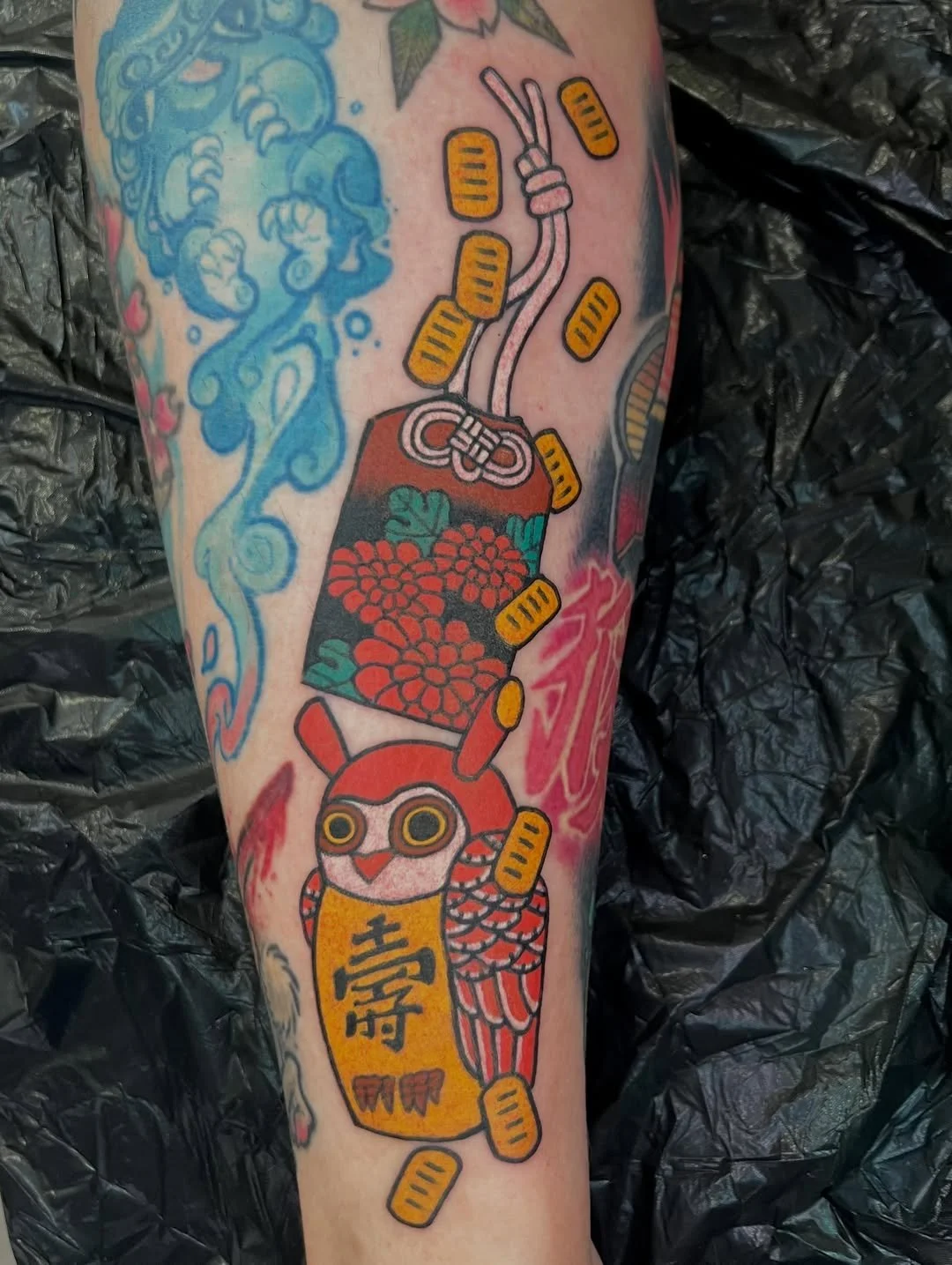
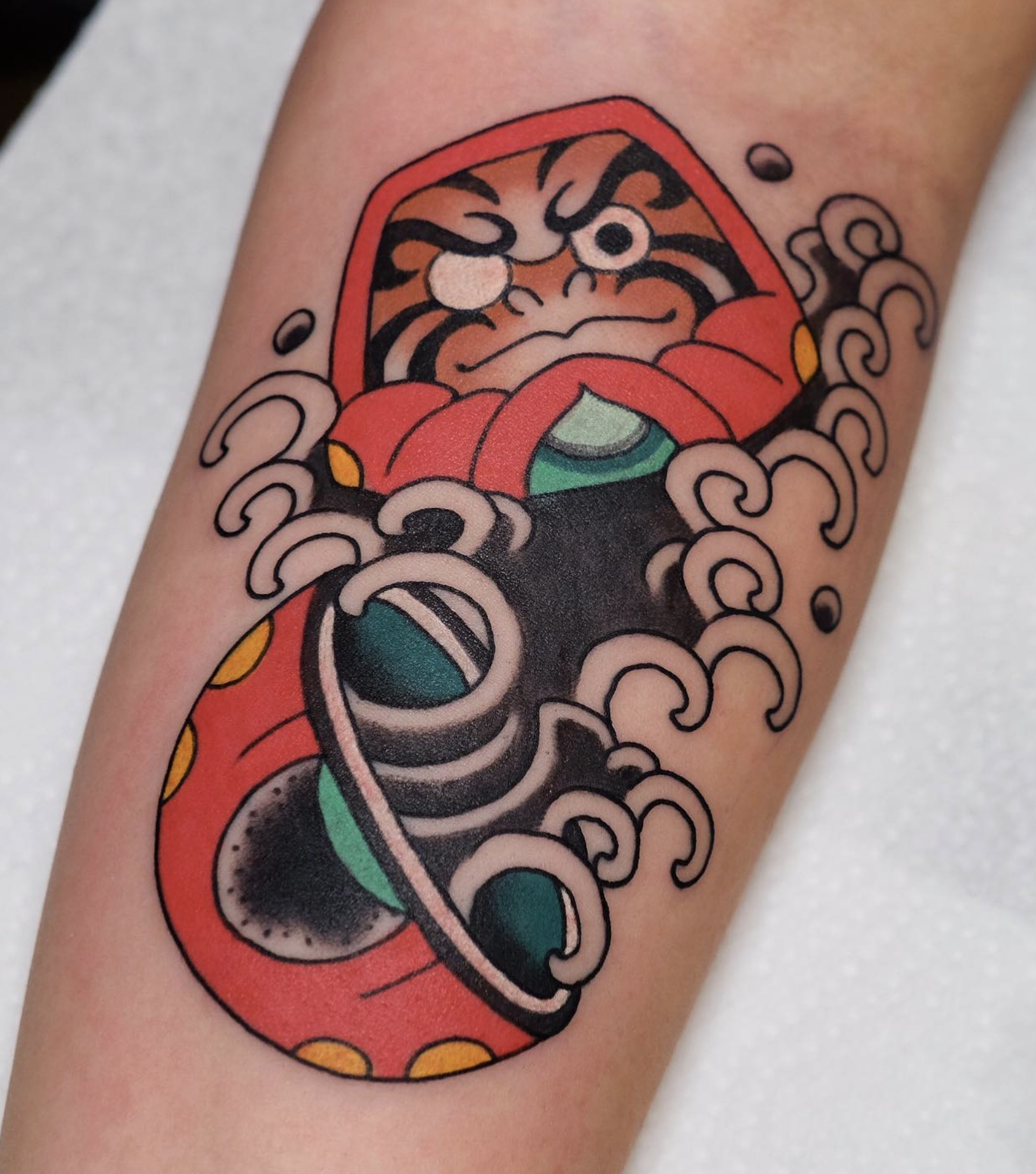
A daruma is the round red doll based on Bodhidharma. You fill in one eye when you start something, and the second eye when you finish. It is a simple design, and on a quiet day it can sometimes be drawn and tattooed in one visit. A hannya, or Fujin and Raijin together, usually needs a drawing done in advance.
What to bring
Two or three reference pictures are plenty. Know the rough size, and whether there is a story or a season you care about. Say if you want bare skin around the figures, or a background of black cloud and wind. Bare skin shows more of the linework. A black background makes the figures stand out, and it takes more hours.
A calf has room for a koi swimming up, or for one mask. Ribs and sleeves have room for water and for a longer design. A chest has room for a pair, such as a hannya with a snake, or Fujin and Raijin. A back has room for a scene. If you commute through central London, think about healing a rib tattoo under a shirt on a hot train before you choose that spot.
Walk-ins are welcome for a conversation, a daruma, or a small flower. Bring the print and ask which parts need a drawing appointment. A sleeve does. So does anything with several figures.
If you have a trip to Japan booked, mention it. Many onsen still refuse guests with tattoos, or ask you to cover them. Better to know that before the tattoo sits somewhere a cover cannot reach.
Prints by Hokusai, Kuniyoshi and Yoshitoshi are out of copyright, so they are fine to bring as reference. Please do not ask us to copy another tattooer's finished sleeve. We can draw a new one for you from the story and the season you have chosen. Book a drawing appointment for that, or start as a walk-in and we will tell you whether it can be done the same day.
Bringing the references in Central London
References get you a better day at Red Point Tattoo than a vague ask for something Japanese. Choose two or three images. Write one sentence: the story, the season, the size. Say whether you want the figures on open skin or set into black cloud and wind. Those two roads use very different amounts of time. Open skin shows more of the drawing. A dark ground makes the figures glow and adds hours. Neither is the serious option by default. Your job and your pain tolerance can decide it. Placement is the next cut. A calf takes a vertical koi or a single mask. Ribs and sleeves take running water. A chest takes a pair, hannya and snake, or the wind and thunder gods. A back holds a whole scene. If your week runs through central London, think about healing in offices, gyms and hot trains before you pick the ribs. Walk-ins welcome is the right door for a first look, a flash-sized flower, or a daruma. Show the artist the print. Ask what must wait for a drawing appointment. A full sleeve is that appointment. So is any scene with several figures. If a trip to Japan is booked, say so. Plenty of onsen still refuse tattooed guests or ask for a cover. That fact should not run your whole design. It should stop a surprise at the bathhouse door. Old prints by Hokusai, Kuniyoshi and Yoshitoshi are long out of copyright. A living tattooer's finished sleeve is not a source to copy. Ask us to draw a new composition for your body, using the old story and your season. That is the work Red Point Tattoo can start from North London, whether you booked ahead or came in under walk-ins welcome.